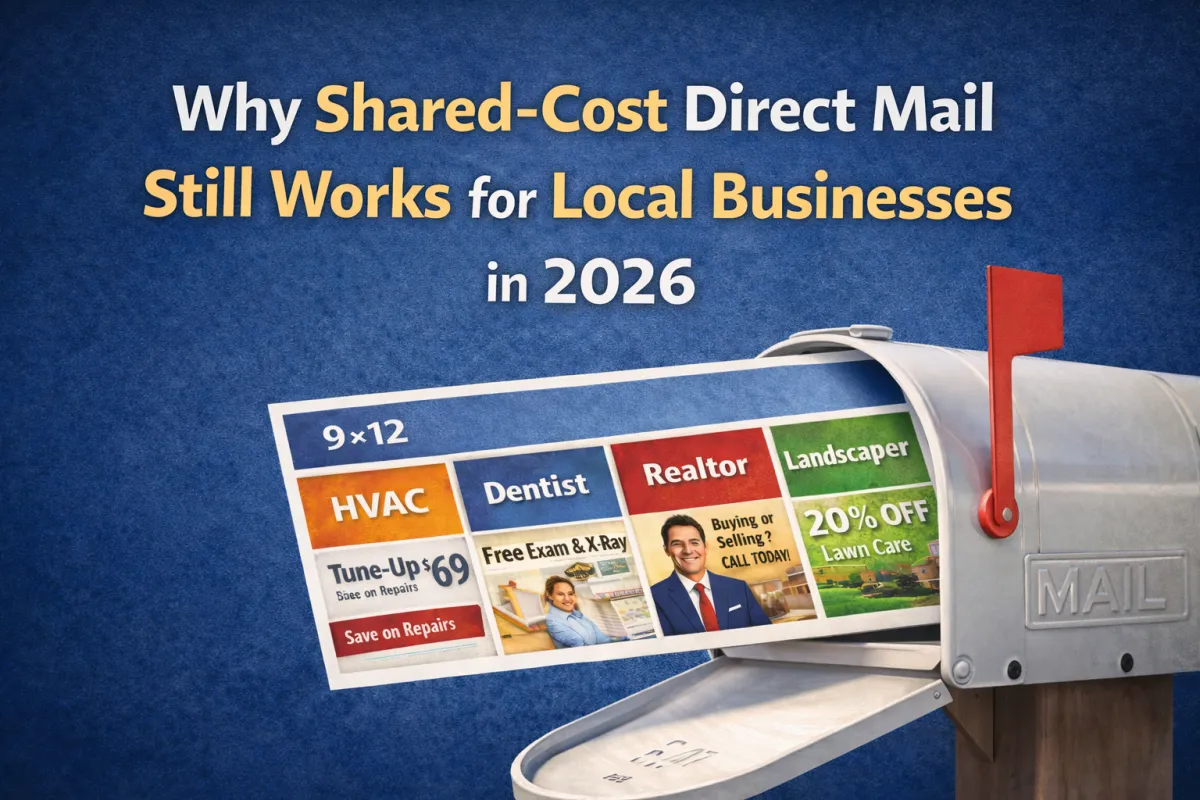
Why Shared-Cost Direct Mail Still Works for Local Businesses in 2026
Every year, marketing experts predict the death of direct mail.
"Email is cheaper!" "Social media has better targeting!" "Nobody checks their mailbox anymore!"
Yet here we are in 2026, and direct mail—particularly large-format shared-cost postcards delivered through USPS EDDM—continues to outperform many digital channels for local service businesses across the Triangle and Triad.
Not because business owners are stuck in the past. But because direct mail solves problems that digital marketing struggles with.
Let me explain why this "old-school" tactic is still one of the smartest investments a local business can make.
The Digital Marketing Fatigue Problem
Your potential customers are drowning in digital noise.
Think about your own experience: How many marketing emails hit your inbox today? How many ads interrupted your social media scrolling? How many websites asked you to accept cookies, subscribe to newsletters, or turn on notifications?
Research from HubSpot shows that average email open rates for business services hover around 20-30%. That means 70-80% of your carefully crafted emails never get read. Social media organic reach has plummeted to single digits for most business pages. Google Ads costs per click continue climbing as competition intensifies.
Digital marketing isn't ineffective—it's just incredibly crowded and increasingly expensive.
Direct mail, by contrast, has a captive audience. When someone brings in their mail, they physically handle every piece.USPS research indicates that 42% of recipients scan or read mail they receive, and promotional mail generates higher engagement than many digital channels.
Why Physical Still Matters
There's something psychologically powerful about physical marketing materials that digital can't replicate.
A postcard sits on your kitchen counter. It's on your refrigerator held by a magnet. It's in your car's cup holder while you're deciding who to call for that home repair you've been putting off.
Digital ads disappear the second you scroll past them. Emails get deleted or buried. But that 9×12 postcard? It has staying power.
Studies on marketing effectiveness consistently show that people trust print advertising more than digital ads. There's a perception of legitimacy and investment—"If they spent money to mail this, they must be a real, established business."
For local service businesses where trust is critical—HVAC companies, dental practices, legal services, home contractors—that perceived legitimacy matters enormously.
The Shared-Cost Model: Making Premium Advertising Accessible
Here's where most small businesses hit a wall with direct mail: cost.
Printing and mailing thousands of full-color 9×12 postcards as a solo advertiser is expensive. Many small businesses simply can't afford to send out premium-sized direct mail consistently enough to build brand recognition.
That's where the shared-cost model changes everything.
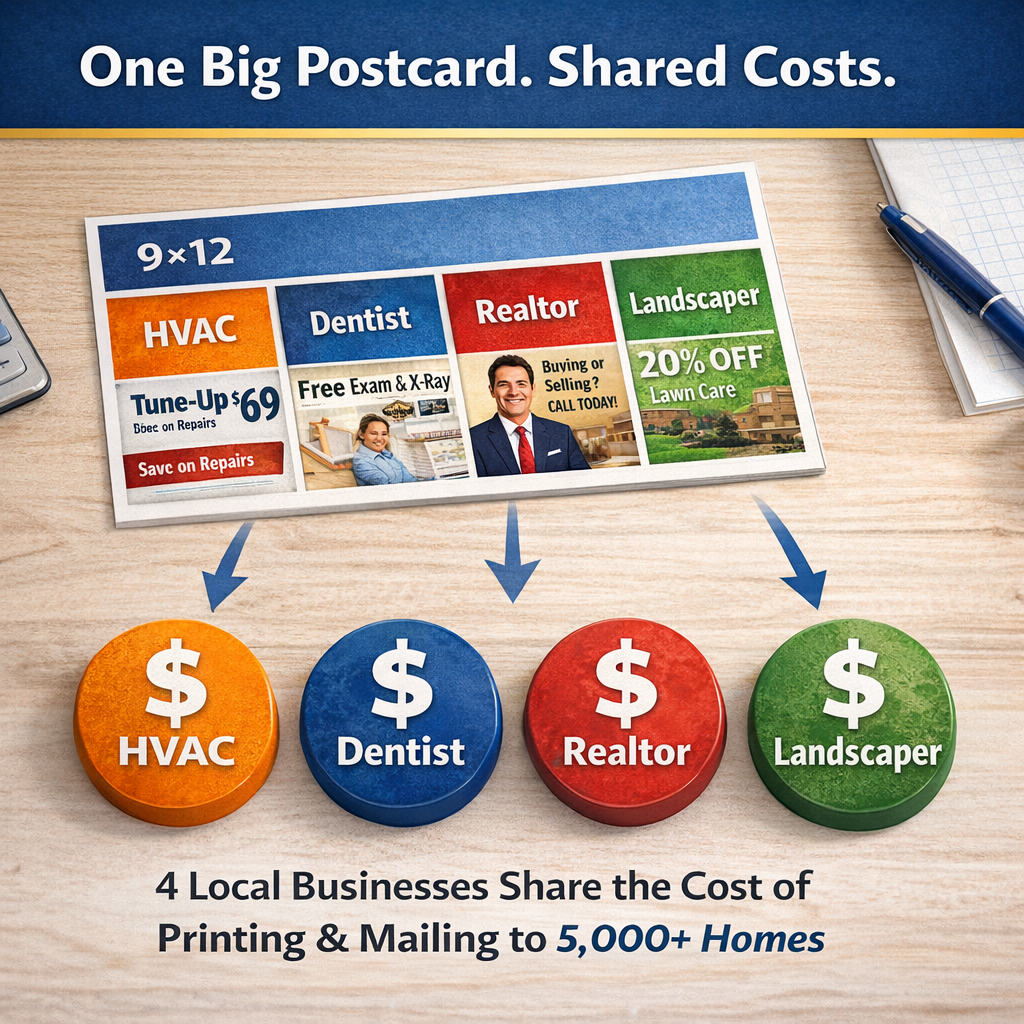
Instead of one business bearing the entire cost of printing and postage, multiple non-competing businesses share the expense. Each business gets exclusive placement in their category (only one HVAC company, one dentist, one real estate agent, etc.), but the costs are split across all participants.
The result: Premium 9×12 postcards delivered to 5,000+ households for a fraction of what solo mailing would cost.
This model makes consistent, repeated exposure affordable—which is critical becausemarketing research shows consumers typically need 7-12 exposures to a brand before taking action.
A solo business might afford one big direct mail push per year. With shared-cost programs, that same business can mail monthly or quarterly—building the consistent presence that actually drives results.
EDDM: Targeting Without the Data Headaches
One of the strongest advantages of USPS Every Door Direct Mail is its simplicity.
WithUSPS EDDM, you select carrier routes based on geographic areas and basic demographics (household income, age ranges, household size). Then your mail goes to every address on those routes—no need for purchasing mailing lists, managing addresses, or dealing with data accuracy issues.
For local service businesses, this geographic targeting is perfect. An HVAC company doesn't need to know names and detailed demographics—they need to reach homeowners in specific neighborhoods where they want to work.
A dental practice wants to reach families within a 5-mile radius of their office. A real estate agent wants to farm specific subdivisions. EDDM delivers that geographic precision without the complexity.
Size Matters: Why 9×12 Outperforms Standard Postcards
Walk to your mailbox and pull out the mail. What stands out?
The small 4×6 postcard gets lost among the letters and catalogs. But a 9×12 postcard—that's impossible to miss.
The larger format provides several strategic advantages:
Visual Impact: More space for compelling imagery, clear headlines, and readable information without cramming everything into a tiny space.
Perceived Value: Recipients unconsciously associate larger, higher-quality mail pieces with established, professional businesses.
Information Capacity: Room to showcase multiple services, include customer testimonials, display before-and-after photos, or feature special offers without cluttering the design.
Staying Power: People are more likely to set aside or save larger, attractive postcards that catch their attention.
For businesses in competitive markets—which describes most of the Triangle and Triad—this visual differentiation can be the difference between getting noticed and getting discarded.
What Makes Shared-Cost EDDM Particularly Effective for Triangle Businesses
The Triangle and Triad regions have specific characteristics that make shared-cost direct mail especially effective:
Strong Community Preference for Local Businesses
Durham, Chapel Hill, Raleigh, Greensboro, and Winston-Salem all have strong "support local" cultures. Residents actively prefer doing business with local companies over national chains when possible. Direct mail from recognizable local businesses reinforces that community connection.
Well-Defined Neighborhood Targeting
The Triangle's geography naturally segments into distinct neighborhoods and communities—Carrboro, Southern Village, Hope Valley, Brier Creek, etc. EDDM routes align perfectly with these community boundaries, allowing precise geographic targeting.
Affluent Demographics in Key Areas
Many Triangle neighborhoods have household incomes and homeownership rates that align perfectly with service-based businesses. TheU.S. Census data shows median household incomes across the Triangle region that support demand for home services, professional services, and wellness businesses.
Less Saturated Than Major Metro Markets
Unlike oversaturated markets in major cities where every mailbox receives dozens of direct mail pieces weekly, the Triangle maintains a healthier balance. Your postcard stands out rather than getting buried.
The Response Patterns That Make Direct Mail Valuable
Here's what actually happens when a well-designed shared-cost EDDM campaign hits mailboxes:
Immediate Response (Days 1-3): Some recipients see the postcard and call or visit your website immediately. These are people who were already thinking about needing your service—your postcard provided the nudge and the contact information at the perfect time.
Short-Term Response (Week 1-2): Others set the postcard aside with intention—"I'll call them when I'm ready to schedule." These prospects might be comparing options, waiting for payday, or planning ahead for seasonal needs.
Long-Term Brand Building (Weeks 2-8): Many recipients don't need your service immediately, but they file away your business name subconsciously. When they eventually do need an HVAC company, a real estate agent, or a landscaper, your name surfaces because they've seen your postcard multiple times.
This multi-stage response pattern is why consistency matters more than one-time reach. A single postcard campaign generates some immediate response. Monthly or quarterly campaigns build cumulative brand recognition that pays dividends over time.
Measuring ROI: What "Working" Actually Means
One challenge with direct mail is attribution—knowing exactly which customers came from which marketing channel. But here's how to measure whether your shared-cost EDDM is working:
Track First-Contact Sources: When new customers call or book online, ask how they heard about you. Include tracking phone numbers or unique URLs on your postcards to measure direct response.
Monitor Campaign Timing: Look for spikes in inquiries and appointments in the week following each mail drop. Compare inquiry volume in months when you mail versus months when you don't.
Calculate Customer Lifetime Value: One new client from a $500 postcard campaign who becomes a repeat customer worth $3,000 over two years represents a 6x return—even if they were the only direct response.
Assess Combined Channel Impact: Many customers need multiple touchpoints. They might see your postcard, visit your website, check your Google reviews, then call. The postcard was part of that conversion journey even if it wasn't the "last click."
For most local service businesses, a shared-cost EDDM campaign that generates 5-15 qualified leads—of which 2-5 convert to customers—represents positive ROI, especially when factoring in customer lifetime value and referrals.
Integration with Digital: The Smart Approach
The most successful Triangle businesses aren't choosing between direct mail and digital marketing—they're using both strategically.
Direct mail drives awareness and initial interest. The postcard lands in mailboxes, creates familiarity, and prompts people to take action—calling, texting, or visiting your website.
Digital captures and converts those responses. Your website provides detailed information and online booking. Your AI agents answer calls 24/7 (even from postcards received on weekends). Your email automation nurtures leads who aren't ready to buy immediately.
This integrated approach—which we covered in detail in our article oncombining AI and direct mail—maximizes the value of both channels.
Common Objections to Direct Mail (and the Reality)
"Nobody looks at junk mail anymore."
People absolutely still look at their mail—they just quickly sort it. That's exactly why size, design quality, and relevant messaging matter. A well-designed 9×12 postcard for a service people actually need gets attention.
"Digital marketing is more measurable."
Digital marketing is more easily tracked, but that doesn't mean it's more measurable in terms of actual business impact. If your Facebook ad generates 100 clicks but zero customers, is that more valuable than a postcard campaign that generates 5 customers but less granular data?
"Direct mail is environmentally wasteful."
This is a fair concern. Responsible direct mail practices include using recycled paper, soy-based inks, and targeting carefully to reduce waste. Many Triangle residents appreciate supporting local businesses enough to accept occasional mail from legitimate service providers versus daily junk from national retailers.
"My target audience is too young for direct mail."
Research from USPS and marketing firms actually shows that millennials and Gen Z respond well to direct mail because they receive so little of it compared to older generations—it stands out as novel rather than routine.

When Shared-Cost EDDM Makes the Most Sense
Direct mail isn't the perfect solution for every business, but it's particularly effective for:
Service Area Businesses: Companies that serve defined geographic regions (plumbers, landscapers, house cleaners, etc.) benefit from EDDM's geographic targeting.
High-Value Services: Businesses where acquiring one customer generates significant revenue can easily justify the campaign investment.
Repeat-Service Models: Companies that establish ongoing client relationships (real estate, financial services, medical/dental) benefit from the long-term brand building.
Visual Services: Businesses that can showcase their work through imagery (renovations, landscaping, design services) leverage the large postcard format effectively.
Seasonal Services: Companies with peak seasons (HVAC, lawn care, pool maintenance) can time campaigns to drive awareness just before demand spikes.
If your business fits these criteria and serves the Triangle or Triad region, shared-cost EDDM likely deserves a place in your marketing mix.
Getting Started with Shared-Cost Direct Mail
If you're ready to test shared-cost EDDM for your business:
Identify your target geography. Which neighborhoods or zip codes contain your ideal customers? UseUSPS EDDM mapping tools to explore carrier routes.
Define your message and offer. What will make recipients interested enough to respond? Special offers, seasonal services, or problem-solving messaging typically perform best.
Design for impact. Professional design matters—sloppy postcards undermine credibility. Invest in quality imagery and clear, benefit-focused copy.
Join a shared-cost program or coordinate with complementary businesses. Find other non-competing local businesses willing to share costs and collaborate on campaigns.
Track and measure results. Use tracking phone numbers, unique URLs, or ask customers how they heard about you to assess campaign performance.
Commit to consistency. Plan quarterly or monthly campaigns rather than one-off efforts to build cumulative brand recognition.
The Bottom Line
In 2026, shared-cost direct mail works for Triangle and Triad small businesses because it solves real problems:
It cuts through digital noise with physical presence
It targets geographic areas precisely where your customers live
It builds trust through tangible, professional presentation
It creates consistent brand exposure at affordable cost
It drives immediate response while building long-term awareness
The businesses succeeding with direct mail aren't using it exclusively—they're integrating it smartly with digital marketing, AI automation, and community engagement to create complete marketing systems.
Is direct mail the only marketing channel you need? No. But is it still one of the most effective investments for local service businesses? Absolutely.
The question isn't whether direct mail works in 2026. The question is whether you're using it as effectively as your competitors—or better yet, more effectively than they are.
Want to test shared-cost EDDM for your Triangle business without massive upfront investment? Wespor Business offers shared-cost 9×12 USPS EDDM programs specifically for local service providers across Chapel Hill, Durham, Raleigh, and the Triad. We handle design, printing, targeting, and mailing—you just show up to serve the customers. Visit wesporbusiness.com or call (984) 217-4555 to learn how shared-cost direct mail can drive qualified leads to your business.


