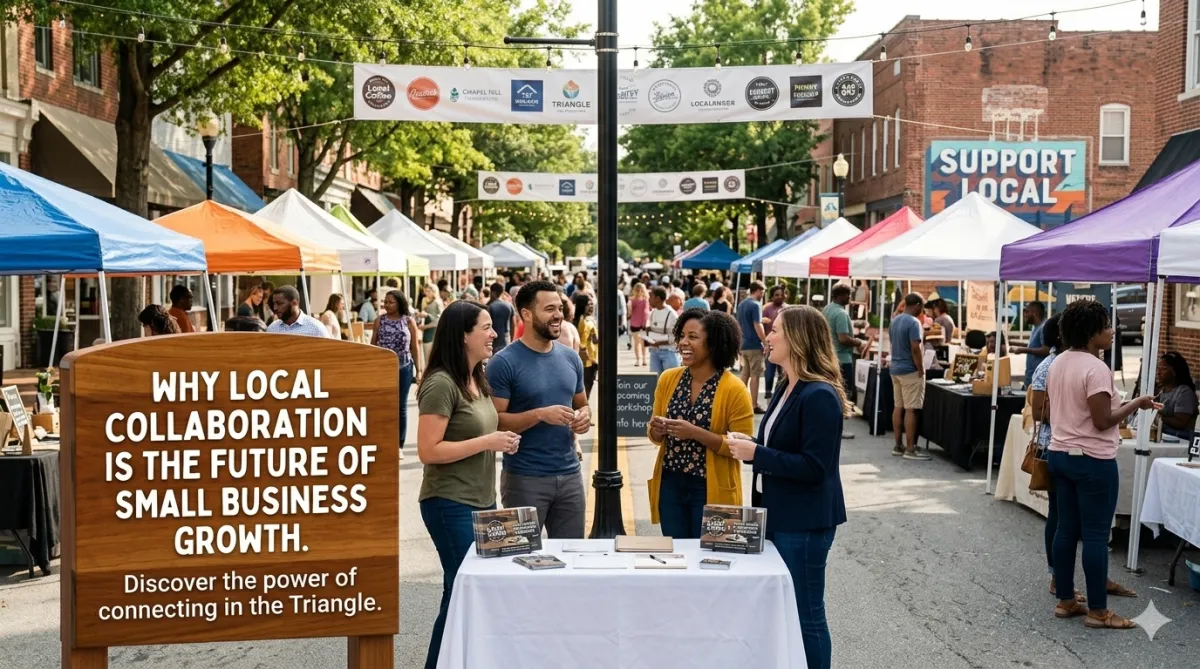
Why Local Collaboration Is the Future of Small Business Growth
There's a myth in business that success comes from outcompeting everyone around you.
Beat the other guy. Protect your secrets. Keep your best strategies to yourself. Win by making sure everyone else loses.
But if you look at the small businesses actually thriving in Chapel Hill, Durham, Raleigh, and across the Triangle—the ones growing sustainably while maintaining work-life balance—you'll notice something different.
They're collaborating more than they're competing.
The most successful local businesses aren't isolating themselves from other entrepreneurs. They're actively building partnerships, sharing resources, making referrals to each other, and creating community-driven growth engines that benefit everyone involved.
This isn't just feel-good philosophy. It's practical strategy backed by measurable results.
The Economic Case for Collaboration
Let's start with the hard business reasoning before we get to the community benefits.
Collaboration reduces marketing costs. When you partner with a complementary business on a joint event, workshop, or promotion, you split the costs while reaching a combined audience. Your $500 marketing budget suddenly has $1,000 worth of impact.
Collaboration expands reach. Your business serves 500 customers. Your partner serves 500 different customers. Through strategic collaboration, you both now have access to 1,000 potential customers—doubling your audience without additional advertising.
Collaboration fills service gaps. When a customer needs something you don't provide, referring them to a trusted partner preserves the relationship. They get help, you look good for the connection, and your partner gets business they'll likely reciprocate.
Collaboration builds credibility. Association with other respected businesses elevates your reputation. When an established business refers you or partners with you, some of their credibility transfers to your brand.
According to research from business collaboration experts, businesses that actively collaborate with complementary partners grow 30-50% faster than similar businesses operating in isolation—while often spending less on marketing and customer acquisition.
This isn't charity. It's strategy.
What Local Collaboration Actually Looks Like
Collaboration doesn't mean merging businesses or sharing profits equally. It means creating specific, win-win arrangements that benefit all parties.
Here are the most effective forms of collaboration we see among Triangle businesses:
Referral Partnerships
The simplest form of collaboration: you refer customers to businesses you trust, and they do the same for you.
Example: A local real estate agent partners with a home stager, mortgage broker, and home inspector. When clients buy or sell homes, the agent refers them to these trusted partners. Those partners reciprocate by referring their clients who need real estate services.
Why it works: Everyone serves the same customer base (homeowners) but provides different services. Referrals are natural, helpful to customers, and mutually beneficial.
Co-Hosted Events and Workshops
Two or more businesses team up to host educational events, workshops, or community gatherings.
Example: A financial advisor and estate planning attorney co-host a "Retirement Planning Workshop" at a local venue. They split costs, combine their email lists, and each speak on their area of expertise. Attendees get comprehensive information; both businesses generate leads.
Why it works: Shared costs, combined audiences, and enhanced credibility through association. Plus, the content is more valuable when multiple experts contribute.
Bundled Service Offerings
Complementary businesses create package deals that combine their services at a slight discount.
Example: A photographer, caterer, and event space create a "Small Wedding Package" priced attractively compared to booking each service separately. All three businesses market the package, sharing the promotional effort.
Why it works: Convenience for customers, differentiation in the market, and shared marketing leverage a single package across multiple businesses' channels.
Shared Marketing Campaigns
Businesses combine resources to execute marketing campaigns none could afford individually.
Example: Five non-competing local businesses share the cost of a shared-cost EDDM postcard campaign, each getting exclusive placement in their category. A 9×12 postcard reaches 5,000 households at a fraction of solo-mailing cost.
Why it works: Premium marketing reach at accessible prices, combined brand exposure, and introduction to each other's customer bases.
Cross-Promotion and Content Collaboration
Businesses promote each other through their marketing channels—social media, email lists, blog content, etc.
Example: A coffee shop and a coworking space create a partnership where coworking members get discounts at the café, and café customers learn about the coworking space through table tents and flyers. Both businesses promote each other on social media.
Why it works: Free marketing exposure through established audiences, added value for existing customers, and natural alignment between complementary services.
Resource and Knowledge Sharing
Businesses share operational knowledge, vendor contacts, best practices, and sometimes even equipment or space.
Example: Several service businesses share office space and reception services, splitting costs while presenting professional fronts they couldn't afford individually. They also share referrals for trusted vendors—accountants, attorneys, insurance agents.
Why it works: Reduced operational costs, faster learning from peers' experiences, and access to vetted service providers.

Why the Triangle Is Perfect for Collaborative Business Models
The Triangle and Triad regions have several characteristics that make collaboration particularly effective:
Strong "Support Local" Culture
Communities like Chapel Hill, Carrboro, and Durham pride themselves on supporting independent local businesses over national chains. This culture naturally encourages businesses to support and promote each other—customers appreciate seeing local businesses working together.
Defined Community Boundaries
The Triangle's geography creates natural community segments—neighborhoods, towns, and districts with distinct identities. This makes it easy to identify complementary businesses serving the same geographic area and customer base.
Active Chamber and Networking Infrastructure
The Durham Chamber of Commerce, Greater Raleigh Chamber, Chapel Hill-Carrboro Chamber, and organizations like WIN Hillsborough create natural environments for identifying collaboration partners and building trust.
Diverse Service Economy
The Triangle has a rich ecosystem of service businesses—professional services, home services, wellness providers, creative professionals, and more. This diversity creates abundant opportunities for non-competing complementary partnerships.
Educated, Collaborative Mindset
The Triangle's highly educated population—influenced by UNC, Duke, NC State, and the broader research community—tends toward collaborative problem-solving rather than zero-sum competition.
These factors combine to create an environment where collaboration isn't just idealistic—it's strategically smart.
The Competitive Advantage of Being Known as a Collaborator
Here's something that might surprise you: being generous with referrals and partnerships makes you MORE competitive, not less.
When you're known as the business that:
Refers customers to trusted partners when their needs don't fit your services
Collaborates with other local businesses on events and initiatives
Shares knowledge and resources with peers
Actively supports the local business community
People want to work with you. Other businesses want to refer you. Customers trust you more because you prioritize their needs over making a sale.
Research from networking and business development experts consistently shows that "connectors"—people and businesses known for bringing others together—receive disproportionate referrals and opportunities compared to those who hoard connections.
This is counterintuitive but true: giving referrals generously generates more referrals back to you than trying to capture every possible customer yourself.
How to Build Strategic Collaborations That Actually Work
Not all partnerships succeed. Here's how to build collaborations that deliver lasting value:
Start with Complementary, Not Competing
Choose partners who serve the same customer base but provide different services. A wedding photographer and florist are complementary. Two wedding photographers are competitors. The distinction matters.
Ensure Value Alignment
Partner with businesses that share your values around quality, customer service, and professionalism. A luxury service provider collaborating with a discount provider creates brand confusion for both.
Make Expectations Explicit
Write down what each party commits to providing. Vague partnerships fail because nobody knows what success looks like. "We'll refer clients to each other" is vague. "We'll include each other in our quarterly email newsletter and mention each other during client consultations" is specific.
Start Small and Build
Don't commit to complex, long-term partnerships immediately. Test with a single co-hosted event or trial referral arrangement. Prove the relationship works before expanding scope.
Track and Measure
Monitor what you're actually getting from partnerships. How many referrals came in? How much did the joint marketing cost versus individual efforts? What was customer feedback? If a partnership isn't delivering value, it's okay to adjust or end it.
Communicate Regularly
Partnerships fail when communication drops off. Schedule quarterly check-ins to discuss what's working, what could improve, and how to enhance collaboration.
Give Before Expecting Reciprocation
The businesses that succeed at collaboration are those who give generously first. Make referrals, promote partners, and provide value before keeping score. Trust and reciprocity follow generosity.

Real Examples of Collaboration Success in the Triangle
Let me share some actual collaboration models working effectively across our region:
The Wellness Collective: Several complementary wellness providers—massage therapist, acupuncturist, nutritionist, personal trainer—share a facility, cross-refer clients, and co-market wellness packages. Each operates independently but benefits from association and shared resources.
The Home Services Network: A group of home service providers (electrician, plumber, HVAC, landscaper, house painter) refer customers to each other and participate in shared-cost direct mail campaigns. When homeowners need one service, they're introduced to the entire trusted network.
The Wedding Vendor Alliance: Photographers, venues, caterers, florists, and DJs collaborate on styled shoots for marketing content, host joint bridal showcase events, and maintain a preferred vendor list they all promote. Couples planning weddings get curated recommendations; vendors get qualified leads.
The Professional Services Hub: Attorneys, CPAs, financial advisors, and insurance agents share office space and reception services while maintaining separate practices. They refer clients across specialties and co-host educational seminars for business owners.
These aren't formal organizations with complex governance. They're smart business owners recognizing that collaboration creates opportunities none could capture individually.
Overcoming the Scarcity Mindset
The biggest barrier to collaboration isn't logistics—it's mindset.
Many business owners operate from a scarcity mentality: "If I refer this customer to someone else, I lose." "If I share my best strategies, competitors will use them against me." "There's not enough business to go around."
This mindset is understandable but ultimately limiting.
The abundance alternative recognizes that:
Referring a customer you can't serve well maintains trust and often generates reciprocal referrals
Sharing knowledge positions you as an expert and builds your reputation
Collaboration expands the total opportunity available rather than dividing a fixed pie
The businesses that help others succeed find themselves surrounded by people eager to help them
Studies on business collaboration show that businesses in strong collaborative networks grow faster, survive economic downturns better, and report higher owner satisfaction than isolated businesses—even when controlling for other factors.
The Community Multiplier Effect
Here's where collaboration becomes particularly powerful: its effects compound.
When you collaborate with Business A, you gain access to their network. When Business A collaborates with Business B, you're one degree removed from Business B's network. As collaborative relationships multiply, the entire business community becomes more connected and supportive.
This creates several compounding benefits:
Increased resilience: When economic challenges hit, connected businesses support each other through referrals, shared resources, and knowledge sharing.
Faster problem-solving: Need a vendor recommendation? Facing a challenge someone else solved? Connected networks provide solutions quickly.
Enhanced reputation: As more businesses vouch for your quality, your reputation strengthens throughout the community.
Greater market influence: A group of aligned businesses can advocate for policy changes, attract events to the area, or shift market norms more effectively than individuals.
Collective marketing power: Collaborative campaigns reach larger audiences and generate more impact than solo efforts.
This multiplier effect is why some business communities—like the Triangle—punch above their weight economically. It's not just individual business success; it's interconnected success that raises all boats.
Making Collaboration Part of Your Business Strategy
If you're convinced that collaboration should be part of your growth strategy, here's how to make it systematic rather than sporadic:
Monthly: Attend at least one networking event or business community gathering. Look for collaboration opportunities, not just customers.
Quarterly: Review your referral partners and collaborative relationships. Are they active? Mutually beneficial? Worthy of continued investment?
Annually: Identify 2-3 new strategic partnerships to develop. Don't just accumulate contacts—build deliberate, value-generating relationships.
Ongoing: When you encounter a customer need you can't fulfill, immediately think "Who in my network could help them?" Make that referral and let your partner know.
Culture: Train your team to think collaboratively. Empower them to make referrals, promote partners, and represent your business as community-focused rather than insular.
This systematic approach ensures collaboration becomes part of your operating model, not something you do occasionally when convenient.
The Future Belongs to Connected Businesses
As markets become more competitive and customer expectations continue rising, the businesses that will thrive are those that leverage collaborative advantages.
Solo operators competing purely on price or marketing spend will struggle against connected networks that share costs, cross-promote, and provide integrated customer experiences.
The question isn't whether to collaborate—it's how strategically you'll approach collaboration and how quickly you'll build those relationships.
The Triangle business owners succeeding most notably aren't the ones trying to dominate their markets alone. They're the ones building strong networks, collaborating generously, and creating win-win relationships that benefit everyone involved.
What kind of business do you want to build? One competing in isolation, or one thriving through collaboration?
The choice—and the opportunity—is yours.
Want to connect with other collaboration-minded Triangle business owners? Wespor Business hosts regular networking events designed to foster genuine partnerships and collaborative relationships among local entrepreneurs. We also offer shared-cost direct mail programs that make collaboration practical and profitable. Visit wesporbusiness.com or call (984) 217-4555 to learn about upcoming events and how we support local businesses growing together.


