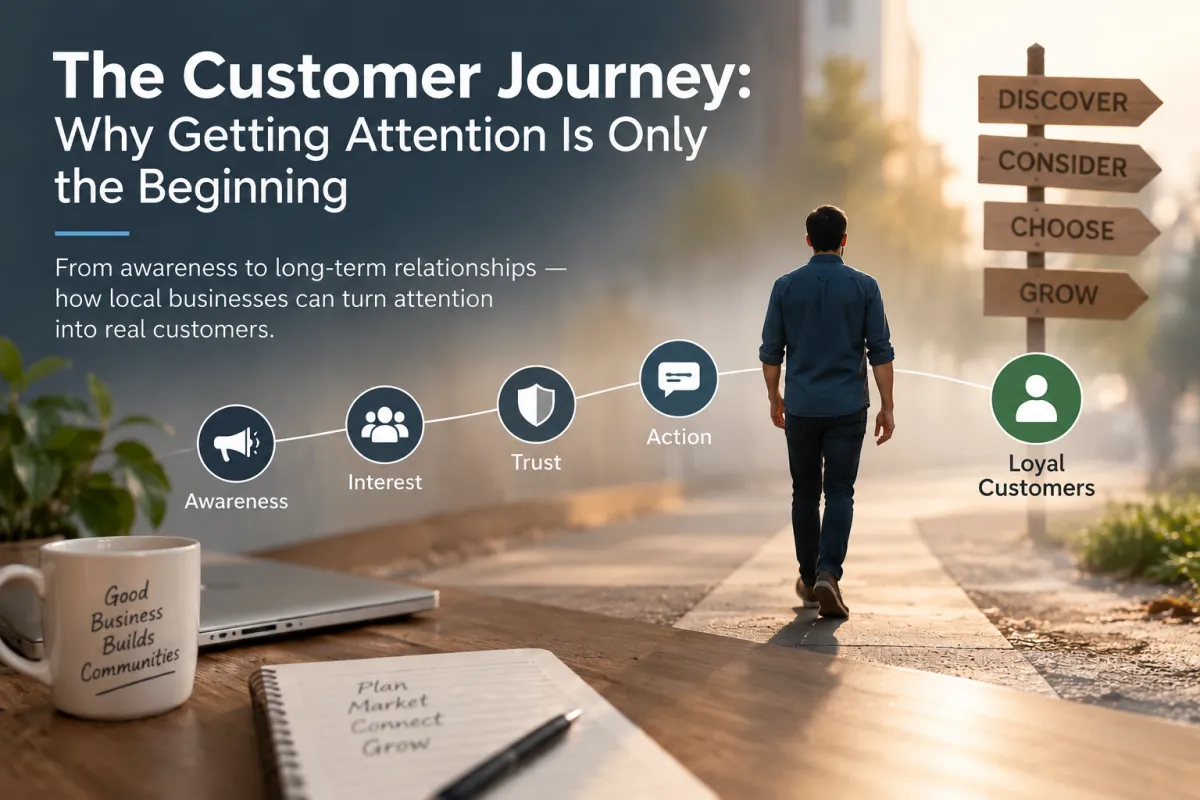
The Customer Journey: From Attention to Customers
Many businesses think marketing is successful when someone sees their advertisement, social media post, website, or postcard.
But being seen doesn't necessarily mean being chosen.
A potential customer can discover your business, visit your website, read your reviews, and still decide not to contact you.
That's because customers don't usually move from awareness to purchase in a single step. They go through a journey.
They need to discover you, understand what you do, decide whether they trust you, and then feel confident enough to take action.
That means your marketing needs to do more than create attention. It needs to guide people toward becoming customers.
The businesses that understand this journey can create a more connected marketing system instead of relying on individual posts, advertisements, or campaigns.
People Don't Become Customers the Moment They See You
Think about the last time you purchased a service from a business you didn't already know.
You probably didn't see one advertisement and immediately buy.
You may have searched for the business.
You may have visited its website.
You may have checked reviews.
You may have looked at social media.
You may have compared other businesses.
You may have asked someone for a recommendation.
Only after doing some of that research did you decide whether to make contact.
Your customers are often doing the same thing.
This is why marketing needs to account for what happens between the first impression and the final decision.
For more on why being visible matters, see Stop Waiting for Customers to Find You.
Stage One: Awareness
The first stage of the customer journey is awareness.
Before someone can consider buying from you, they need to know you exist.
They might discover your business through:
• Google Search
• Google Business Profile
• Facebook
• LinkedIn
• Direct mail
• Networking
• Referrals
• Blog content
• Community events
• Word of mouth
The specific channels will vary depending on your business and audience.
The important thing is that your potential customers have opportunities to encounter your business.
A person may not need your service today.
But they may need it next month.
Or three months from now.
Or next year.
If they have already seen your business several times, you have a better chance of being remembered when the need appears.
Awareness Doesn't Automatically Create Interest
Being visible is important, but visibility alone isn't enough.
Once someone notices your business, they need a reason to care.
This is where your message becomes important.
Your marketing should quickly help potential customers understand:
What do you do?
Who do you help?
What problem do you solve?
Why should they consider your business?
What should they do next?
If your marketing simply says, "We're the best," it doesn't give the customer much information.
Instead, show them that you understand their problem.
Explain something they may be struggling with.
Answer a question they have.
Show them how your service works.
Give them a reason to learn more.
This is where useful content becomes valuable.
Content Helps Customers Move Forward
A customer may not be ready to contact you immediately.
That doesn't mean your marketing has failed.
They may simply need more information.
A blog article can answer a question.
A social media post can explain a problem.
A video can demonstrate your expertise.
A testimonial can provide reassurance.
A case study can show what working with your business looks like.
Each piece of content can move someone one step further along the journey.
This is one reason businesses should think beyond promotional content.
Not every piece of marketing needs to ask for the sale.
Sometimes the goal is simply to help the customer understand why the problem matters and what options are available.
Trust Is Built Before the First Conversation
Once someone becomes interested, another question appears:
"Can I trust this business?"
This is one of the most important stages of the customer journey.
Customers are taking a risk when they choose a business they don't know.
They want reassurance.
They may look at:
• Reviews
• Testimonials
• Website quality
• Social media activity
• Business information
• Photos
• Credentials
• Customer stories
• Educational content
All of these can influence the impression they form.
Your marketing therefore needs to make it easy for people to understand that your business is legitimate, active, knowledgeable, and capable of helping them.
This connects with the issue discussed in Why Being the Best Business Doesn't Guarantee More Customers.
Being good at what you do matters.
But customers need opportunities to recognize that quality before they make a decision.
Your Website Is Part of the Customer Journey
A customer may discover you through Facebook but visit your website before contacting you.
They may find you through Google and then look at your social media.
They may receive a postcard and type your business name into Google.
They may hear about you from a friend and search for reviews.
Your channels are connected.
That means your website needs to support the rest of your marketing.
When someone arrives, they should be able to understand what you do quickly.
Your services should be clear.
Your location should be easy to find.
Your contact information should be obvious.
Your website should make the next step simple.
If customers have to search for basic information, you create unnecessary friction.
Don't Make Customers Work Too Hard
Imagine that a customer has already decided they are interested.
They search for your business.
They find your website.
But they can't find your phone number.
Or they don't know how to request a quote.
Or your website doesn't explain what happens next.
Or your business information looks outdated.
That customer may leave.
The frustrating part is that the marketing may have worked.
The customer found you.
They became interested.
But the customer journey broke down before contact.
This is why local businesses need to think about the complete journey rather than focusing on a single marketing channel.
Discovery is important.
But so are credibility, consideration, contact, and follow-up.
The Decision Stage
Eventually, the customer reaches a point where they have to decide.
"Should I contact this business?"
This is where clarity matters.
A strong call to action tells people exactly what to do.
For example:
• Call today
• Request a quote
• Schedule a consultation
• Book an appointment
• Get an estimate
• Contact our team
The right call to action depends on the business.
The principle remains the same.
Don't make customers guess.
Tell them what the next step is.
The First Conversation Matters
When someone finally contacts your business, the customer journey enters another important stage.
The prospect is no longer simply researching.
They are now interacting directly with you.
The conversation can influence whether they continue or move somewhere else.
This is why the first interaction should be professional, clear, and focused on understanding what the customer actually needs.
Ask questions.
Listen.
Understand the problem.
Explain the next step.
Don't assume that every prospect is ready to buy immediately.
The purpose of the conversation is often to help both sides determine whether there is a good fit.
Follow-Up Is Part of Marketing
A conversation that doesn't immediately result in a sale isn't necessarily a lost opportunity.
The customer may need time.
They may need to speak with a partner.
They may be comparing options.
They may need to review pricing.
They may simply not be ready yet.
This is where follow-up becomes important.
A business that follows up consistently creates additional opportunities for prospects to move forward.
A business that never follows up leaves the outcome entirely to chance.
For more on this part of the process, see Why Local Businesses Lose Customers Before They Even Get Contacted.
The Journey Doesn't End With the Sale
One of the biggest mistakes businesses make is thinking the customer journey ends when someone buys.
It doesn't.
The sale creates another opportunity.
A satisfied customer can become a repeat customer.
They can leave a review.
They can refer a friend.
They can recommend your business to another company.
They can purchase another service.
They can become a long-term customer.
That means the experience after the sale matters just as much as the marketing before it.
Communication matters.
Service matters.
Follow-up matters.
The way you handle problems matters.
Every interaction contributes to the customer's overall impression.
Existing Customers Can Become Future Growth
Your existing customers already know your business.
They have already crossed the initial trust barrier.
That makes them an important part of your long-term marketing strategy.
Depending on your business, you may be able to create additional opportunities through:
• Repeat purchases
• Additional services
• Renewals
• Referrals
• Reviews
• Customer appreciation
• Follow-up campaigns
Instead of constantly focusing on finding completely new customers, look at how you can strengthen relationships with the customers you already have.
This doesn't mean ignoring new customer acquisition.
It means recognizing that growth can come from multiple parts of the customer journey.
Marketing Should Connect the Journey
A strong marketing system connects the stages.
Social media can create awareness.
Your website can provide information.
Reviews can build confidence.
Blog content can answer questions.
Direct mail can create local visibility.
Networking can create relationships.
Sales conversations can identify opportunities.
Follow-up can keep those opportunities moving.
Customer service can strengthen relationships.
Referrals can introduce new customers.
Each activity has a role.
The mistake is expecting one channel to do everything.
Look for the Gaps
One of the easiest ways to improve your marketing is to walk through the customer journey yourself.
Start with a simple question:
How would a stranger discover my business?
Then ask:
What would they see?
What would they learn?
What would make them trust me?
Could they easily contact me?
What happens after they contact me?
What happens if they don't buy immediately?
What happens after they become a customer?
The answers can reveal gaps you may not notice when looking at individual marketing activities.
Build a Simple Customer Journey
You don't need a complicated system to start.
Think about your customer journey as:
Awareness → Interest → Trust → Contact → Conversation → Customer → Retention
At each stage, ask what your business is doing to move people forward.
If awareness is weak, improve visibility.
If interest is weak, improve your message.
If trust is weak, strengthen reviews, testimonials, and educational content.
If contact is weak, simplify your call to action.
If conversion is weak, examine your sales conversation and follow-up.
If retention is weak, improve the customer experience and communication.
The objective is not to make every stage perfect.
It's to make the entire journey work together.
Think Beyond the First Sale
A customer may be worth much more than their first transaction.
They may purchase again.
They may refer someone.
They may leave a review.
They may introduce you to another business.
They may remain a customer for years.
That means the real value of marketing isn't always visible in the first transaction.
The relationship can continue creating value long after the original lead was generated.
This is why businesses should think about the customer journey as a long-term process instead of a single event.
Final Thoughts
Getting attention is important.
But attention is only the beginning.
The real opportunity comes from what happens after someone discovers your business.
Can they understand what you do?
Can they see why your business is credible?
Can they find the information they need?
Can they easily contact you?
Does someone respond?
Is there a clear next step?
Are they followed up with?
And once they become a customer, are you giving them reasons to stay connected?
Your customers experience all of these interactions as one journey.
Your marketing should do the same.
Don't just ask how many people saw your business.
Ask what happened after they saw you.
Because marketing becomes much more powerful when attention turns into interest, interest turns into trust, trust turns into action, and action turns into lasting customer relationships.


